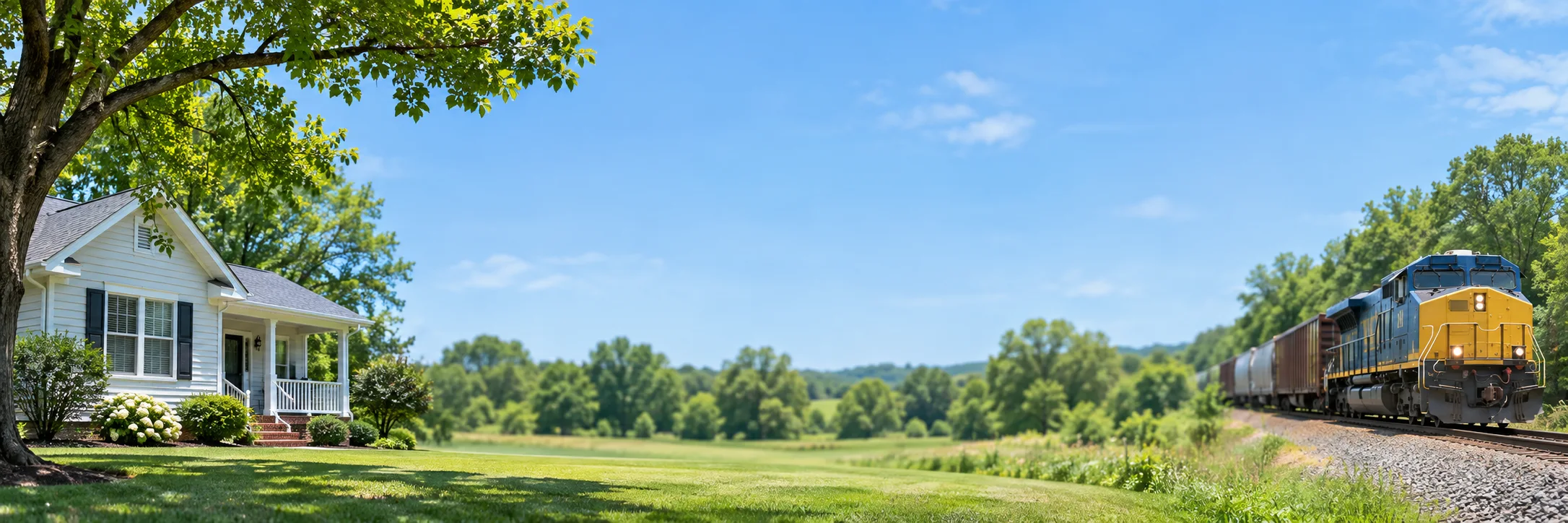
Start with the question the listing will not answer
A listing may say a home is “near transit,” “backs to open space,” or simply show railroad tracks on the map. That does not tell you how active the line is, whether trains move at night, or whether a nearby public crossing may trigger routine horn use. For a buyer, those operational details matter more than the line on the map.
Check the nearest public grade crossing
Train horns are closely connected to public grade crossings and applicable quiet-zone rules. A property can sit beside tracks yet experience very different horn exposure depending on where the nearest public crossing is located. The first useful measurement is therefore not only distance to rail, but distance to the nearest active crossing.
Separate daytime and nighttime train activity
A midday showing can be misleading. Freight activity may be concentrated outside normal showing hours. FRA crossing inventory records can include reported daytime and nighttime thru-train movements. Treat those numbers as reported estimates rather than a live schedule, and check the record year before relying on them.
Do an evening visit before you waive contingencies
Federal data is a screening tool, not a substitute for being there. Visit once during the evening and, if the property is a serious candidate, again late at night or early in the morning. Stand inside bedrooms with windows closed and open, then spend several minutes outside. Ask immediate neighbors about horns, vibration, idling, switching, and blocked crossings.
Important: FRA train-count fields are reported inventory estimates, not live schedules. Noise and vibration at a specific property depend on local conditions and should be verified on site.
A worksheet for the showing
- Nearest mapped rail line: distance and map location.
- Nearest reported crossing: street and crossing ID.
- Day/night train estimates: values and reporting year.
- Quiet-zone status: designation, hours if reported and unknown fields.
- On-site observations: room, window position, time, horns and vibration.
Keep database facts and observations in separate notes. A brief quiet visit does not establish a nightly pattern, and an old reported count does not prove today’s schedule.
Compare the corridor with the road outside
Some homes have both nearby rail and a busy road. Use reported road traffic to identify another source to investigate. Vehicle counts are not an equivalent measure of train activity or indoor noise; do not combine them into a made-up score.
Questions for neighbors and the seller
Ask specifically about overnight trains, routine versus occasional horns, stopped trains, crossing delays and changes in operations. Walk the route to places you use regularly and inspect the crossing in person. This report does not determine resale value, insurance terms or whether a particular buyer should purchase the home.
Use the three-home comparison process for a consistent shortlist and the noise-source checklist for other local activity.
Check a U.S. property address
See the nearest reported grade crossing, day/night train movements, quiet-zone status, speed fields, and crossing incident history.
Frequently asked questions
Can federal data tell me exactly when the next train will pass?
No. FRA crossing inventory train counts are reported estimates, not a live freight timetable.
Does a quiet zone mean I will never hear a train horn?
No. Quiet zones restrict routine horn sounding at covered public crossings, but horns can still be used in emergencies and other permitted situations.
Should I rely on the database alone before buying?
No. Use it to identify issues to verify, then visit the property during relevant hours and ask nearby residents about actual conditions.
Sources and reporting limits
Consult the FRA crossing inventory resources and FRA horn and quiet-zone guidance. Read our source coverage and limitations alongside the report.